Published to the Deerfield Valley News in December 2021 and printed in their December 30th edition
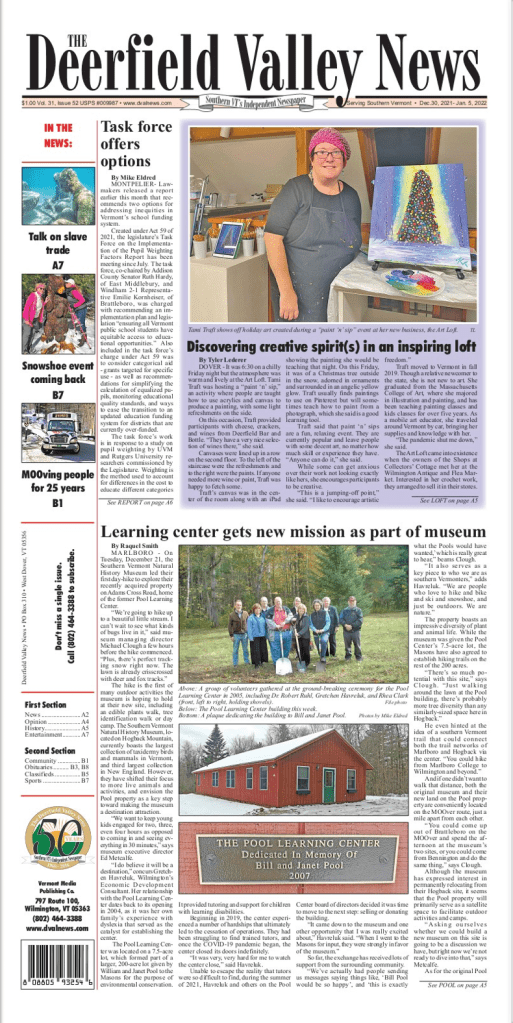
MARLBORO – On Tuesday, December 21, the Southern Vermont Natural History Museum led their first day-hike to explore their recently acquired property on Adams Cross Road, home of the former Pool Learning Center.
“We’re going to hike up to a beautiful little stream. I can’t wait to see what kinds of bugs live in it,” said museum managing director Michael Clough a few hours before the hike commenced. “Plus, there’s perfect tracking snow right now. The lawn is already crisscrossed with deer and fox tracks.”
The hike is the first of many outdoor activities the museum is hoping to hold at their new site, including an edible plants walk, tree identification walk or day camp. The Southern Vermont Natural History Museum, located on Hogback Mountain, currently boasts the largest collection of taxidermy birds and mammals in Vermont, and third largest collection in New England. However, they have shifted their focus to more live animals and activities, and envision the Pool property as a key step toward making the museum a destination attraction.
“We want to keep young kids engaged for two, three, even four hours as opposed to coming in and seeing everything in 30 minutes,” says museum executive director Ed Metcalfe.
“I do believe it will be a destination,” concurs Gretchen Havreluk, Wilmington’s Economic Development Consultant. Her relationship with the Pool Learning Center dates back to its opening in 2004, as it was her own family’s experience with dyslexia that served as the catalyst for establishing the center.
The Pool Learning Center was located on a 7.5-acre lot, which formed part of a larger, 200-acre lot given by William and Janet Pool to the Masons for the purpose of environmental conservation. It provided tutoring and support for children with learning disabilities.
Beginning in 2019, the center experienced a number of hardships that ultimately led to the cessation of operations. They had been struggling to find trained tutors, and once the COVID-19 pandemic began, the center closed its doors indefinitely.
“It was very, very hard for me to watch the center close,” said Havreluk.
Unable to escape the reality that tutors were so difficult to find, during the summer of 2021, Havreluk and others on the Pool Center board of directors decided it was time to move to the next step: selling or donating the building.
“It came down to the museum and one other opportunity that I was really excited about,” Havreluk said. “When I went to the Masons for input, they were strongly in favor of the museum.”
So far, the exchange has received lots of support from the surrounding community.
“We’ve actually had people sending us messages saying things like, ‘Bill Pool would be so happy’, and ‘this is exactly what the Pools would have wanted,’ which is really great to hear,” beams Clough.
“It also serves as a key piece to who we are as southern Vermonters,” adds Havreluk. “We are people who love to hike and bike and ski and snowshoe, and just be outdoors. We are nature.”
The property boasts an impressive diversity of plant and animal life. While the museum was given the Pool Center’s 7.5-acre lot, the Masons have also agreed to establish hiking trails on the rest of the 200 acres.
“There’s so much potential with this site,” says Clough. “Just walking around the lawn at the Pool building, there’s probably more tree diversity than any similarly-sized space here in Hogback.”
He even hinted at the idea of a southern Vermont trail that could connect both the trail networks of Marlboro and Hogback via the center. “You could hike from Marlboro College to Wilmington and beyond.”
And if one didn’t want to walk that distance, both the original museum and their new land on the Pool property are conveniently located on the MOOver route, just a mile apart from each other.
“You could come up out of Brattleboro on the MOOver and spend the afternoon at the museum’s two sites, or you could come from Bennington and do the same thing,” says Clough.
Although the museum has expressed interest in permanently relocating from their Hogback site, it seems that the Pool property will primarily serve as a satellite space to facilitate outdoor activities and camps.
“Asking ourselves whether we could build a new museum on this site is going to be a discussion we have, but right now we’re not ready to dive into that,” says Metcalfe.
As for the original Pool Learning Center, Havreluk said, optimistically, that there is interest in continuing to have symposiums, educational trainings, and scholarships throughout the region.
“That’s one way we can still continue our mission, even if we don’t have a building,” she says.
It seems that the museum forms a perfect meeting point between the Pool family’s legacy of environmental conservation, and the Pool Center’s legacy of education, and they plan to keep both of those missions in mind as they develop the new location.
“There are so many statistics now that demonstrate how taking kids outside improves their school performance,” emphasizes Clough. “We hope that we can partner with the Pool Learning Center, and they can get their kids back on that land.”
Havreluk expressed her thanks for the countless donations and support over the years that kept the Pool Center going.
“Without them, we wouldn’t have been able to do it,” she said.
Anyone interested in donating to or volunteering at the Southern Vermont Natural History Museum can visit www.vermontmuseum.org/support.
 Raquel Anais